
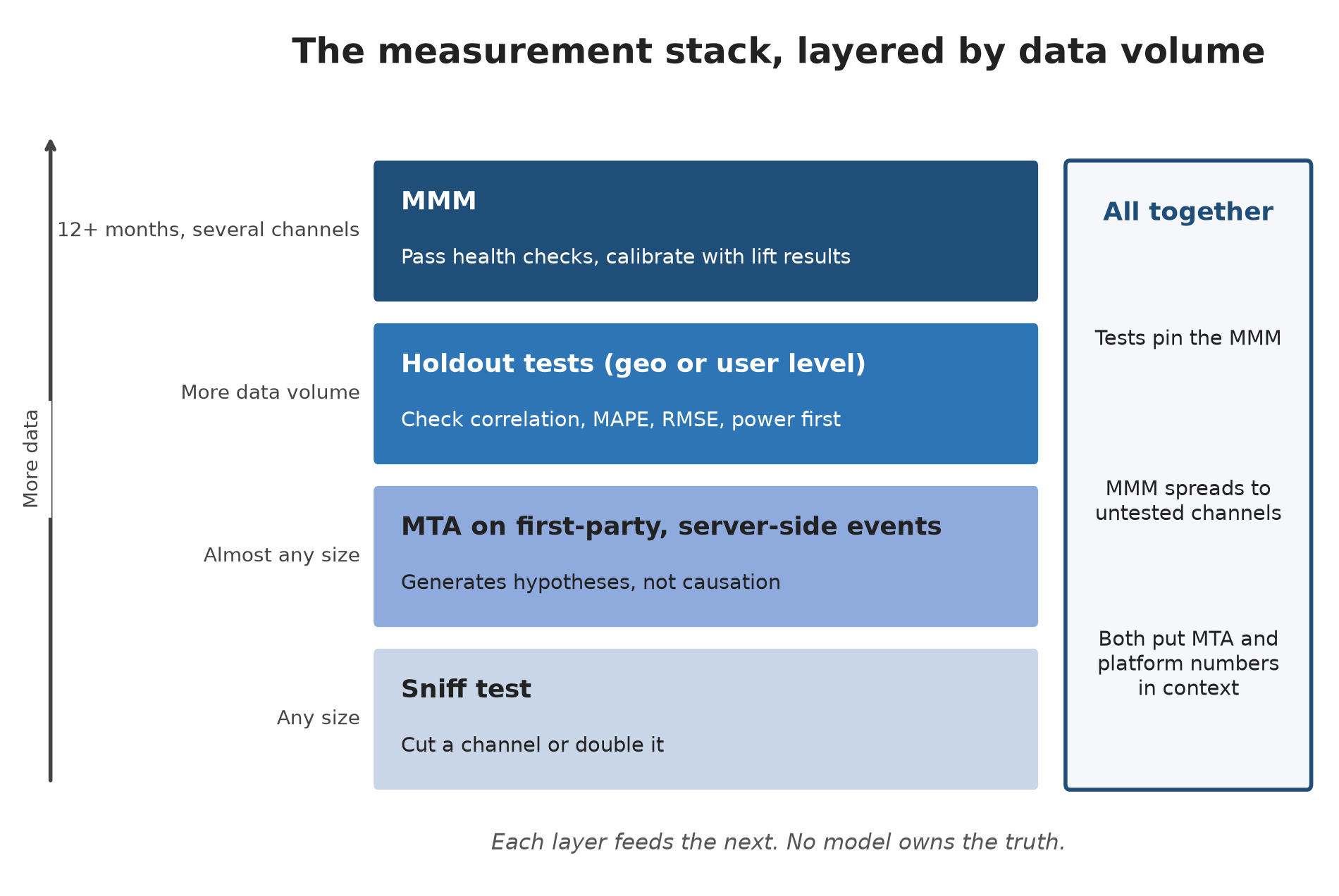
What measurement stack does a DTC brand need? It depends on your data volume, not a spend number. Any brand can run a sniff test. Most can add an MTA on first-party, server-side events. With more volume, add holdout tests. With about a year or more of data across several channels, add an MMM. Then use them together.
Meta, Google and your other platforms all claim the same sale. Added up, they claim more sales than you had. So which number decides where the next dollar goes?
None of them on their own. The customer may have clicked several of those ads, and each one may deserve some credit. I gave the short answer to that question here. This is the longer guide.
The right answer changes as you grow. It's less about how much you spend and more about how much data you have: orders, channels and history. Here's the stack I'd build at each stage, and how each layer makes the next one better.
What can a business of any size do?
Run a sniff test. Cut a channel, or double it. Or do both, one after the other, and watch your total sales.
It won't be perfect. Clean answers take a lot of data, and you may not have that yet. That's fine. Take some swings and see what your store sales do.
What it feeds: a first hunch about which channels matter. Write it down. You'll check it later.
What can almost any business add?
A multi-touch attribution model, or MTA. An MTA spreads credit for each order across the ad touches that came before it.
Build it on first-party, server-side events, with a way to match one customer across devices. Some partners can set this up for a fair price, and some will share the raw event data so you can load it into your own warehouse.
Here's the catch. An MTA doesn't show what caused a sale. It shows the path people took. That's still useful. It gives you eyes on the road, so you can see what's happening right now, especially when you try something new.
Last click undervalues upper-funnel channels. They're rarely the last click, and TV and radio show no clicks at all. A multi-touch view helps, but it still only sees touches it can track.
What it feeds: hypotheses. "Prospecting video seems to start a lot of paths. Is it really adding sales?" That's a question for the next layer.
When are you big enough for holdout tests?
When you have enough volume for a clear answer. A holdout test turns ads off for part of your audience or some regions, then compares sales with the part that still saw ads.
You can run it by region (a geo test) or by user, inside the ad platforms. Running the test often costs little out of pocket. The real cost is the sales you might give up in the regions or audience where ads are off, if those ads were working.
Geo tests need more volume, so check before you commit. Ask a few questions:
- Do your test and control regions move together over time? Check the correlation.
- After you scale the control to match, how far off is it? Look at MAPE (average percent error) and RMSE (a measure of typical error size). Lower is better.
- Is the test well powered? Given your planned spend and the lift you expect, could the test detect a real effect?
If the answers look weak, you may not be ready for a geo test yet. If power is low, run the test longer first, then add spend in the test cell, then grow the cell. A user-level test, such as a platform's own lift study, might work instead. It's run by the platform, covers one channel at a time, and depends on how well that platform matches people across devices. Or go back to sniff tests and MTA for now. Before you call a geo test feasible goes deeper on these checks.
Holdouts have an ugly truth, too. You remove ONE channel, but several channels may have worked together to make the sale. A test tells you a lot about that channel. It tells you less about the mix.
What it feeds: real-world snapshots. Each test gives you a trusted read on one channel during one window. You'll use those to pin down the next layer.
When does an MMM make sense?
When you have about 12 months of data or more across several channels (more history helps), with enough spend and variety to pass a set of health checks. An MMM (marketing mix model) uses spend and sales over time to estimate what each channel adds.
It sees the whole mix at once, including channels that never get a click. It also handles the mix question a single holdout can't.
But an MMM on its own can tell a very confident wrong story. That's why the test results matter so much. Feed your lift results into the model. Here's more on what an incrementality test can calibrate in an MMM. And if you're gathering inputs, start with what to put in your MMM.
What it feeds: a view of the whole budget, including channels you haven't tested.
How do all the layers work together?
This is where it pays off. I think of it like a map. Your tests pin the map to the wall in a few places. The MMM spreads the map out with your fingers to cover the channels you haven't tested.
Then both of those give context to what you see in your MTA and in each platform. If Meta claims a channel is crushing it, but your test and model say otherwise, you know how much to discount the dashboard.
No model owns the truth. Each layer checks the others. When they disagree, that's where your next test goes.
Then you test again, refit the model, and update your read on the dashboards. Repeat, forever.
Where should you start?
Start where your data is today, not where you wish it was. If you're small, run a sniff test this month. If you have the volume, put holdout tests on your calendar with the rest of your 2027 measurement plan.
Ready to try a holdout? Grab the free Geo Test Planning Kit. It helps you plan treatment and control markets and log each test's power before you spend.
If you want to know which layer fits your data today, shoot me a note to talk through it: Schedule a call.
FAQ
Do I need an MMM if I'm a small brand?
Probably not yet. An MMM usually needs about 12 months of data or more across several channels, and more history helps. Start with sniff tests and an MTA, then add holdout tests when you have the volume.
Does an MTA show which ads caused sales?
No. An MTA shows the paths people took before buying. It's great for spotting patterns and forming hypotheses. A well-powered holdout test shows what one channel caused during the test.
How do I know if I have enough data for a geo test?
Check whether your test and control regions move together, how small the error is after scaling, and whether the test is well powered for your planned spend.
Why use several methods instead of one?
Each method sees part of the picture. Tests give trusted reads on single channels. An MMM spreads those reads across the whole budget. MTA and platform data show what's happening day to day.