
What is a DTC measurement plan for 2027?
A 2027 DTC measurement plan decides three things during Q4 budget season: which spend questions matter most, which tests will answer them, and when each runs. Set aside budget and calendar time for holdout or geo tests on your biggest or least-trusted channels. Then use the results to calibrate attribution and, once you have the data, an MMM.
A framework tells you how to think about measurement. A plan puts dates and owners on it. It says which test runs in which quarter, who reads the result, and which budget call it feeds. If your plan has no dates, it's still a framework.
Which measurement decisions should you make during Q4 budget season?
Budget season is when test money and calendar time get spent or saved. Make these calls before the 2027 numbers are locked:
- Hold back test budget and calendar windows. A test needs spend you're willing to move and weeks you're willing to wait. Both are easiest to protect before the year starts.
- Pick the channels with the biggest budget questions. I'd start with 2 or 3, where the most money rides on an answer, or where you trust the reporting least.
- Agree with finance on the number that decides spend. I treat store revenue and first-party orders as the source of truth, because every platform reports its own view.
- Agree in advance what happens when methods disagree. Your attribution, a test and an MMM will often tell different stories. No model owns the truth, so decide now which evidence wins for which call. These questions to ask an attribution vendor can help.
Last click undervalues upper-funnel channels, so a plan built only on last-click reports will keep starving the channels that create demand. If first-touch vs last-touch attribution is still how your team splits the budget, put that on the list too.
What should your 2027 test calendar look like, quarter by quarter?
Here's one way to lay it out. This is an illustrative example, not a real client plan, and it has no lift numbers.
| Quarter | Focus | Example test | Output |
|---|---|---|---|
| Q1 | Clean data, first test | Audit for duplicate purchase events and messy UTMs. Make store revenue and first-party orders the source of truth. Then run a holdout on your biggest or least-trusted channel against the post-holiday baseline. | A trusted sales number and a first read on one channel |
| Q2 | Upper funnel | Test an upper-funnel channel, like video or prospecting social. Start or refresh your MMM inputs. | A read on a channel last click tends to miss |
| Q3 | Calibrate | Feed the test results into attribution and an MMM. Pre-test the holiday plan. | Better-grounded channel readings before Q4 |
| Q4 | Holiday (optional) | A holiday or Black Friday geo test, only if it was planned early and passes a power check. | Results for the 2028 budget |
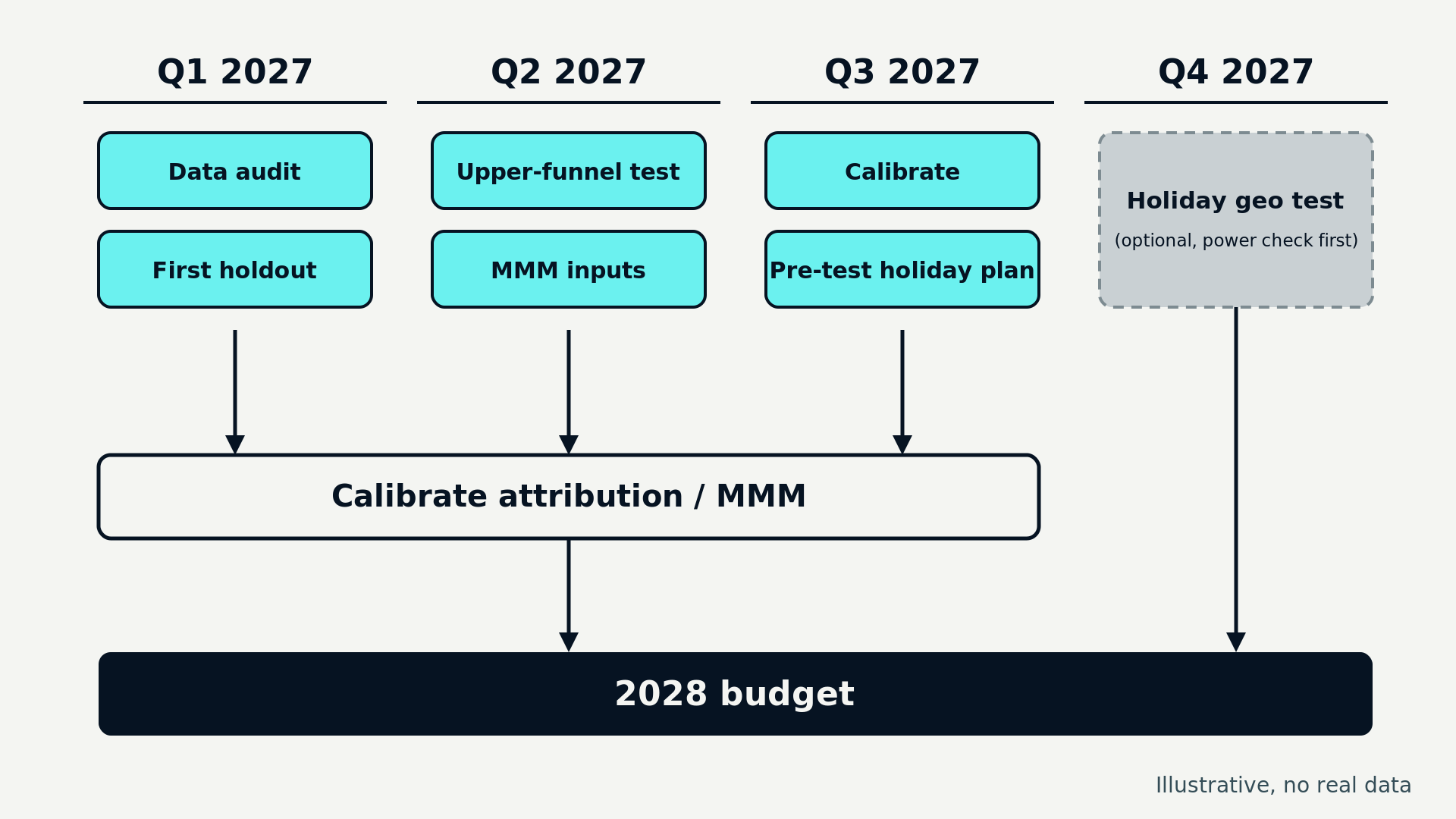
For test length, use the geo test duration planner. To see what a test can show, try the geo test signal planner. It's a planning aid, not a power calculator.
About the Q4 test. A holiday geo test is optional, not a must. Holiday weeks are noisy. Promos, shipping cutoffs and demand spikes can swamp a lift read, and markets can drift apart. Plan it early, and run a power analysis on your own geo history, including past holiday weeks. If the power isn't there, skip it and read your Q1 to Q3 results into the 2028 budget instead.
To plan any of these tests, you can grab my free Geo Test Planning Kit, a public Notion template with no sign-up.
How should the plan change by business size?
Different spend levels and channel counts call for different tools. Here's how I'd tier it.
- Any size of business: run a sniff test. Compare platform totals to store revenue. If you're small, cut a channel, or double it, and watch what happens. It won't be perfect, but it beats guessing.
- Almost any size: use click-based attribution for daily calls. Multi-touch attribution is great for spotting patterns and keeping eyes on the road. It doesn't show what caused a sale.
- A bit larger: run holdout tests. Geo or user-level holdouts need some data volume to give clear answers. First check that your control and test cells track each other and that the test will be well powered.
- Larger still: build an MMM and calibrate it with tests. Then use all of these together. Tests snapshot what a channel added during the test. The MMM fills in the channels you haven't tested.
How big and how long should your 2027 geo tests be?
Swing for the fences on spend and length. The most common mistake I see is tiptoeing in. A team spends too little, for too short a time, and ends with "we couldn't tell."
Holdouts, where you turn a channel off in some markets, are usually bold enough. Subtle tests often aren't. Either way, run a power check on your own geo history before you commit. If power is low, run longer first, then add spend in the test cell (prorated to its share), then grow the cell.
The incrementality testing framework walks through planning a test step by step. If you'd like the test run for you, see geo holdout testing for DTC brands.
Where does an MMM fit in a 2027 plan?
An MMM gives you a portfolio view of how each channel seems to add to sales. It needs history to learn from. My rule of thumb is about 12 months. More history helps.
Tests make an MMM more believable. You can calibrate an MMM with test results, so the model's reading of a tested channel stays close to what the test found. Calibration can't fix bad spend data or a test from a different season, though. If you don't have about 12 months yet, put the MMM on the 2028 plan and start collecting clean data now.
What should you ask a measurement vendor before signing for 2027?
Ask how the tool's numbers get checked against real-world tests, and what happens when they disagree. Ask how it credits channels that rarely get the final click. Ask whether you keep the raw records and model outputs if you leave. Use these questions to ask an attribution vendor before you sign.
Want help building your 2027 plan?
Bring your channel list, a rough range for annual ad spend and your biggest budget question. We'll work out which tests belong in which quarter. Build your 2027 measurement plan with me.
FAQ
When should a DTC brand build its 2027 measurement plan?
During Q4 budget season, before test budget and calendar windows are spent. Once the 2027 budget is locked, it's much harder to free up money and weeks for a test.
How many incrementality tests should we plan for 2027?
There's no set number. I'd start with the 2 or 3 channels that hold your biggest budget questions. Add more tests only when each one feeds a real budget call.
Do small DTC brands need an MMM in 2027?
Often not yet. An MMM needs history to learn from. My rule of thumb is about 12 months. More history helps. Smaller brands usually get more from sniff tests and holdouts first.
Should we run a geo test during Black Friday or the holidays?
Only if you plan it early and the decision is worth it. A holiday geo test is optional, and holiday weeks are noisy. Run a power analysis on your own geo history first, including past holiday weeks, and skip the test if the power isn't there.
What's the difference between a measurement plan and a measurement framework?
A framework explains how to think about measurement. A plan puts dates, owners and budget calls on it. It says which test runs when and which decision it feeds.
Does last click still have a place in a 2027 plan?
Yes, for daily optimization. It's quick and easy to read. But it undervalues upper-funnel channels, so don't let it set the budget split.