
The question (paraphrased from a reader on Reddit): Meta, Google and my other platforms each claim credit for the same sales. Added up, they claim more sales than I actually had. Which number should I use to decide where my budget goes?
Quick answer: None of the platform numbers on its own. The customer may have clicked several of those ads, and they may all share some responsibility. What decides spend depends on your size: start with simple sniff tests, add multi-touch attribution (MTA), then holdout tests, then a marketing mix model (MMM), and eventually use all of them together.
Why do the platforms all claim the same sale?
Because each one only sees itself. A customer might click a Google ad, see a Meta ad, and come back through an email. Each platform can see its own touch and count the sale.
And honestly? They may each deserve some of it.
Spoiler alert: I'm going to say run a holdout test. But the ugly truth of holdout tests is that you remove ONE channel from the equation, when more than one channel may have played a role in concert with the others. That's why the plan changes as your spend and channel count grow.
Here's what I'd do at different sizes of media portfolio.
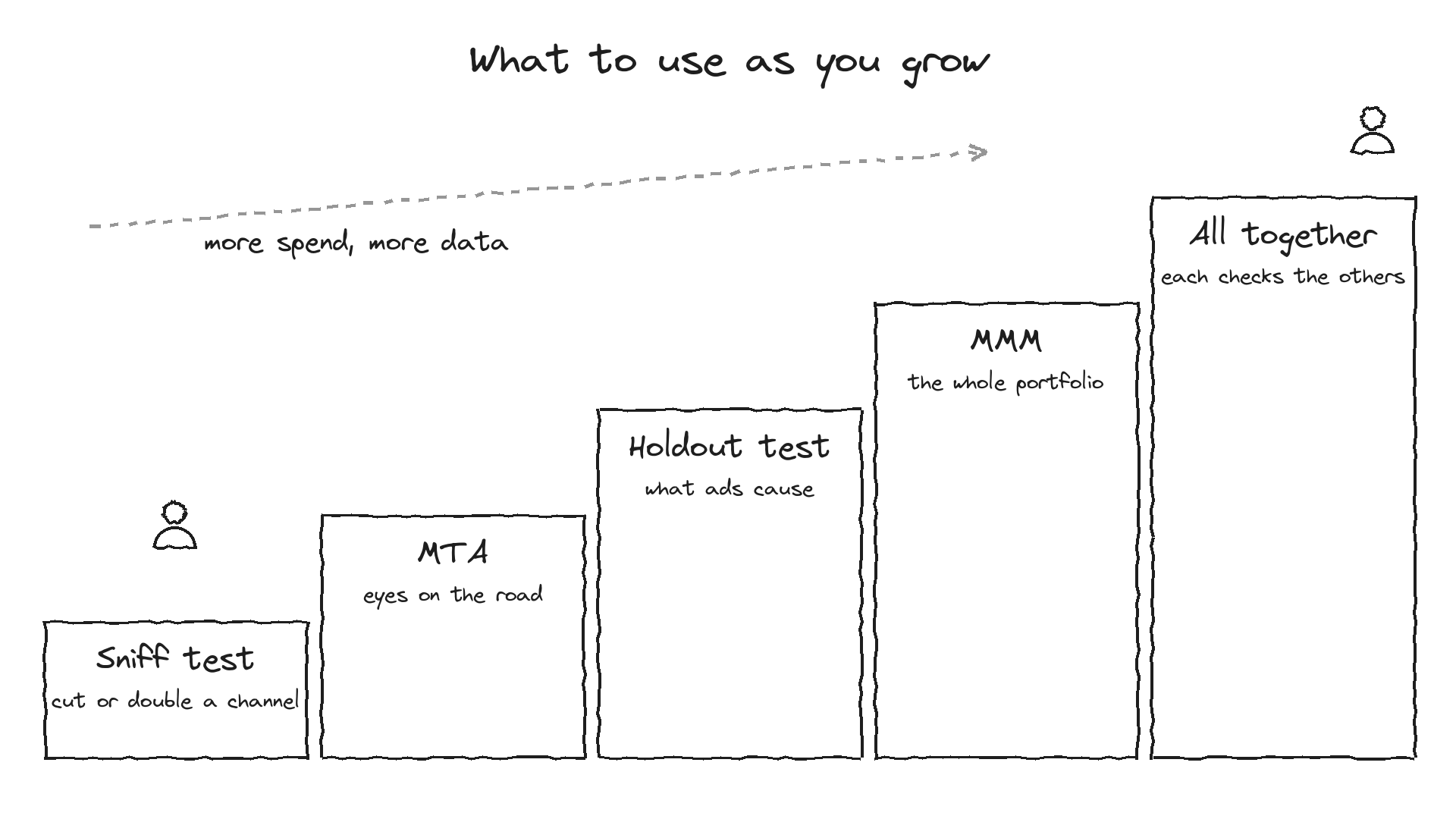
What can any size of business do?
Do a sniff test.
If you're small, just cut a channel. Or double it. Or both, one after the other, and watch your total sales. It won't be perfect. Better data takes a lot of data, and if that's not in your budget, just take some swings.
What can almost any size of business add?
Build a multi-touch attribution model (MTA, a model that spreads credit for each order across the touches that came before it).
There are affordable partners who can do first-party, server-side event tracking and user identity resolution (connecting one person's visits across devices). Some will share the event data with you to load into Google BigQuery. Once that data is pouring in, you can use an AI assistant to help build a pretty advanced MTA.
But know what it can't do. An MTA doesn't reveal what CAUSED a sale. It's great for generating hypotheses and getting "eyes on the road" about what's happening now. Especially if you're about to try something new.
When is a holdout test worth it?
When you're a little bigger.
A holdout test turns ads off for a group (regions, or users) and compares their sales with a group that keeps seeing ads. Geo holdouts don't come with a platform fee. You can choose your regions using your GA4 data, with an AI assistant helping on the analysis. Or you can run a user-level holdout inside Meta (a conversion lift study) or Google (Conversion Lift based on users, if your account is eligible).
Why is this on the next step up? It needs data volume to give clear answers, especially the geo version. How much spend and how many results you need will vary by business.
Check before you commit. Some questions to ask of your data:
- Can you build a control group and a treatment group of regions whose sales move together?
- After scaling, is the error between them low? (MAPE, mean absolute percentage error, and RMSE, root mean squared error, are the usual measures.)
- Will the test be well powered, given your spend plans and the lift you expect?
The geo-test power check walks through that math.
When does an MMM make sense?
When you're bigger still.
An MMM (marketing mix model) estimates what each channel adds to sales using your history, not user tracking. A believable one needs at least 12 months of data from several channels, with enough spend volume and variety to pass a series of health checks. Even better if you build your lift test results into it. See what an incrementality test can calibrate in an MMM.
What does "all of them together" look like?
This is where the biggest portfolios end up:
- Holdout tests snapshot what's happening in the real world.
- The MMM gets pinned to those test results, then extends the model from there to the channels you haven't tested.
- Both of those give you context for what you see in your MTA and in each platform's own reporting.
The platforms still report. You just stop letting any single one of them set the budget. No model owns the truth. And remember that last click undervalues upper-funnel channels, so a channel that looks weak in the platform view may look different once a test or an MMM weighs in.
So which number decides spend?
The one that's closest to cause, at the size you're at today. For a small brand, that's a sniff test. For a big one, it's tests and an MMM checking each other.
If you're trying to work out which step you're on, here's how I work with brands on measurement.
Happy advertising, and reach out with questions!
Need one number your team can act on?
Your tools will disagree. I'll help you choose which number guides spend for a business your size, and how to check it. One-off and short projects are fine.
FAQ
Why do Meta and Google both claim the same sale?
Each platform sees its own ad touch and counts the sale. A customer who clicked both ads can be counted by both.
Which attribution number should decide my ad budget?
No single platform's number. Use the method closest to cause that your size supports: sniff tests, then MTA, holdout tests and MMM.
Does multi-touch attribution show what caused a sale?
No. MTA shows the touches before a sale. It's useful for hypotheses and monitoring, but a holdout test is what shows cause.
How much data does an MMM need?
My rule is at least 12 months, from several channels, with enough spend volume and variety to pass health checks.