
What is a marketing measurement glossary? It defines the terms DTC teams meet in attribution dashboards, incrementality tests and an MMM. Attribution assigns credit for sales. Incrementality measures what ads added beyond what would have happened anyway. An MMM estimates each channel's contribution from spend and sales history. Each term links to a deeper guide.
You've got a report open. It says "iROAS" in one column and "adstock" in a footnote. Somebody on the call says the MTA and the MMM disagree. What do those words mean, and which ones should change your budget?
That's what this page is for. Each entry is short. It tells you what the term means, where it shows up in a budget decision and where to read more.
How do I use this glossary?
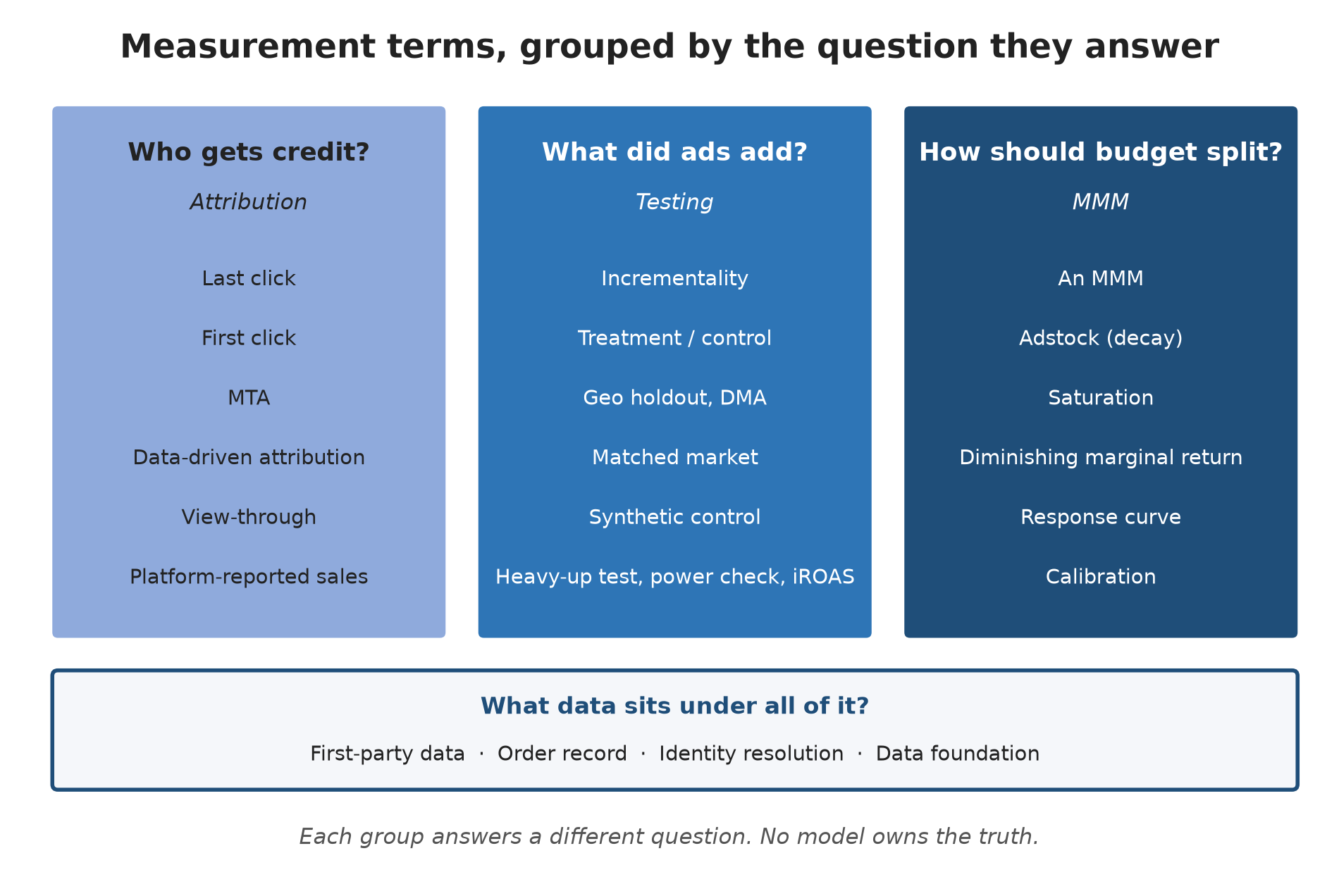
Find the question you're trying to answer, then jump to that group:
- Who gets credit for a sale? Attribution terms
- What did the ads add? Testing terms
- How should the budget split? MMM terms
- What data sits under all of it? Data terms
A-Z: adstock, calibration, data foundation, data-driven attribution, diminishing marginal return, DMA, first click, first-party data, geo holdout, heavy-up test, identity resolution, incrementality, iROAS, last click, matched market, MMM, MTA, order record, platform-reported sales, power check, response curve, saturation, synthetic control, treatment and control, view-through.
Creative metrics get their own page later.
What do the attribution terms mean?
Attribution hands out credit for sales that already happened. It tells you which touches were in the path. It doesn't tell you which touches caused the sale. For the full rundown, read attribution models explained.
Last click
All the credit goes to the final touch before the order. It's simple and fast. But last click undervalues upper-funnel channels. Where it shows up: the default view in many dashboards, and every argument about whether to cut prospecting.
First click
All the credit goes to the first touch. It flips the bias of last click. It favors the channel that found the customer and ignores what closed the sale.
MTA (multi-touch attribution)
An MTA spreads credit for each order across the ad touches that came before it. To work well, it needs first-party data on resolved user identities, so one person's visits on different devices count as one path. It's great for spotting patterns and forming hypotheses. It doesn't show causation. More in MTA questions and limits. Here's how I build MTA.
Data-driven attribution
A model decides how to split credit across touches, based on the paths it sees. Rules-based attribution uses a fixed rule instead. It's still attribution. It splits credit for observed sales. It doesn't measure what the ads added.
View-through
Credit for a purchase after someone saw an ad but didn't click it. A common Meta setting, for example, is 7-day click and 1-day view. Where it shows up: the gap between what a platform reports and what your order table shows.
Platform-reported sales
The sales each ad platform says it drove, using its own rules and windows. Meta, Google and the rest can all claim the same order. Added up, they can claim more sales than you had. Read when platforms claim the same sales and why MTA and MMM disagree.
What do the testing terms mean?
Tests answer a different question: what did the media add? For the basics, start with what is geo testing or how I run incrementality tests.
Incrementality
The sales that wouldn't have happened without the media. You measure it against a comparison, like a holdout. Where it shows up: the decision to keep, cut or scale a channel.
Treatment and control
In a holdout, the treatment group keeps the ads running and the control group has them paused. In a heavy-up test, the treatment group gets the extra spend. The gap between the groups, after you account for how they normally differ, is the estimated effect.
Geo holdout
A test where you pause a channel in some locations and keep it running in others, then compare sales. It uses your own sales by location, so it doesn't depend on tracking each user.
DMA (Designated Market Area)
A TV market area. There are more than 200 in the U.S., so you have more room to find good test and control matches than with 50 states. You can place a sale in a DMA through GA4, or by mapping billing zip codes to DMAs. Billing location isn't always where someone saw the ad, so neither method is perfect.
Matched market
A design that compares the test area with real markets whose sales tracked it in the past. Back-test the pairing before launch.
Synthetic control
A design that compares the test area with a weighted blend of other markets, built to match its sales history. It can match the treatment market's history closely, but it may need more of the country and limit how many tests you run at once. Compare the two in matched market vs synthetic control.
Heavy-up (spend-up) test
A test where you raise spend in the treatment areas. It asks how far to scale, while a holdout asks whether a channel adds anything at all.
Power check
A check, before you spend, of whether the test can detect the effect you care about. If it can't, a "no result" tells you very little. See the geo test power check.
iROAS (incremental return on ad spend)
Incremental revenue divided by the spend that drove it. It comes from a test, so it can differ from the ROAS a platform reports. It applies to the spend level and conditions you tested.
What do the MMM terms mean?
An MMM looks at the whole budget at once. Start with what should I put in my MMM or how I build marketing mix models.
MMM (marketing mix model)
An MMM estimates each channel's contribution to sales from spend and sales history over time. It's observational. It gets stronger when you calibrate it with lift tests. Where it shows up: the annual or quarterly budget split.
Adstock (decay)
How long an ad's effect lingers. In model terms, it's how much of this week's effect carries into next week. A geo test can help show how long sales take to move.
Saturation
The point where more spend in a channel brings back less and less. An MMM has to assume a shape for it. Ask whether a channel only looks good under one narrow saturation setting.
Diminishing marginal return
Each extra dollar in a channel returns less than the dollar before it. This is the question behind "should we spend more here?"
Response curve
A line that shows how sales change as spend in a channel goes up or down. An MMM estimates it from your spend history. Spend-level tests can help shape it, for example several treatment cells at different spend levels, waves of higher and lower spend, or a treatment cell spending above the control's baseline. Don't stretch it far past the spend levels you've seen or tested.
Calibration
Using lift test results to anchor what an MMM says about a channel. Tests pin the map to the wall. The MMM spreads that read to channels you haven't tested. Read what an incrementality test can calibrate in an MMM and why use multiple MMM models.
What do the data terms mean?
Every method above sits on the same data. If the data disagrees, the methods will too.
First-party data
Data you collect yourself: your orders, your site events, your customer records. A geo test can run on first-party sales by location, like billing state or billing zip.
Order record
The one table of orders every report should agree on. If your MTA and MMM don't share one order record and one set of spend definitions, they aren't even arguing about the same thing. See GA4, Shopify and the order record.
Identity resolution
Connecting one person's visits across devices and browsers. An MTA depends on it. Geo tests that place sales by billing location or DMA don't.
Data foundation
The shared data, definitions and checks under your reports. Start small, with the records that drive a budget call. See the marketing data foundation.
Which tools on this site use these terms?
- The geo test calculator helps you size a test.
- The geo test duration planner helps you plan how long it runs.
- The measurement readiness quiz and the MMM or incrementality quiz point you to a next step.
No single model owns the truth. Each term above names one piece of the picture. If you want to know which measurement fits your budget question, shoot me a note to talk through it: Schedule a call.
FAQ
What is the difference between attribution and incrementality?
Attribution gives credit for observed sales to the touches a buyer had. Incrementality is the sales that wouldn't have happened without the media, measured against a comparison like a holdout. Use attribution to run channels day to day. Use tests to decide where budget goes.
What does iROAS mean?
iROAS is incremental return on ad spend: the extra revenue a test measured, divided by the spend that drove it. It applies to the spend level and conditions you tested.
What is adstock in an MMM?
Adstock is how long an ad's effect lingers. In an MMM, it's how much of this week's effect carries over into next week. It's also called decay.
What is a DMA in a geo test?
A DMA is a TV market area. There are more than 200 in the U.S. Geo tests often use DMAs as test and control areas because they give more room for good matches than states do.