
The question (paraphrased from a reader on Reddit): My Meta retargeting campaign shows a great ROAS. But these are people who already put something in their cart. Is the campaign creating those sales, or just taking credit for sales that would have happened anyway?
Quick answer: You're right to ask, and it's probably some of each. Meta reports the sales your retargeting ads observe, not the sales they cause. To find out how many they cause, run a lift test: hold some eligible people back from your ads and compare what they buy with what the people who saw your ads buy. That difference, divided by spend, is your iROAS.
Why does Meta give retargeting so much credit?
Because the ad was there. If someone abandoned your cart recently, there's no guarantee the next ad pushed them back to a purchase. But there's a solid chance that ad got in front of them, because Meta clearly understands the signal and the intent.
So the ad gets the sale.
I call these "observed" sales. Inside Meta's own reporting, a sale gets credited to a Meta ad the person clicked, engaged with or saw within your attribution window. Other channels' touches don't count against it. That's a lot like last click, and last click undervalues upper-funnel channels while it flatters the ad standing closest to the checkout. Retargeting stands very close to the checkout.
An observed sale is a sale your ad was near. A caused sale is one that wouldn't have happened without it.
How does a lift test answer it?
You split people who are eligible to see your ads into two groups:
- Holdout (control) group. These people are sidelined and don't see your ads. You just watch whether they buy anyway.
- Treatment group. These people see your ads as normal.
Then you compare, and the extra sales in the treatment group are the sales your retargeting caused. Hopefully that's all of the sales Meta reported. I think you'll usually find it's fewer.
Meta has a built-in way to do this in its Experiments tool (a conversion lift study). The share of people held out isn't fixed, so check what your study uses before you read the results.
What is iROAS?
Incremental ROAS. It's the revenue your ads caused per dollar of spend:
iROAS = (treatment revenue − control revenue, with the groups scaled to the same size) ÷ spend
The "scaled to the same size" part matters. If the holdout is a small slice of your audience, you can't compare its raw revenue to the much bigger treatment group. Size them up to match first.
What's the "magic multiplier"?
Once you have an iROAS, you can turn it into an incrementality factor. I call it the "magic multiplier." It's silly, but it's all we have sometimes.
It's just iROAS divided by the ROAS Meta reports. Then you multiply future platform-reported results by that factor to estimate what they're really adding.
Example (synthetic numbers, for illustration only): I spend $10,000 on retargeting during the test. Meta reports $70,000 in attributed revenue, so a 7.0x ROAS. After scaling, my treatment group brings in $15,000 more revenue than my holdout. That makes my iROAS 1.5x ($15,000 ÷ $10,000). My incrementality factor is 1.5 ÷ 7.0 = about 0.21. From here on, I'd multiply Meta's reported retargeting revenue by about 21% to estimate the part it actually caused.
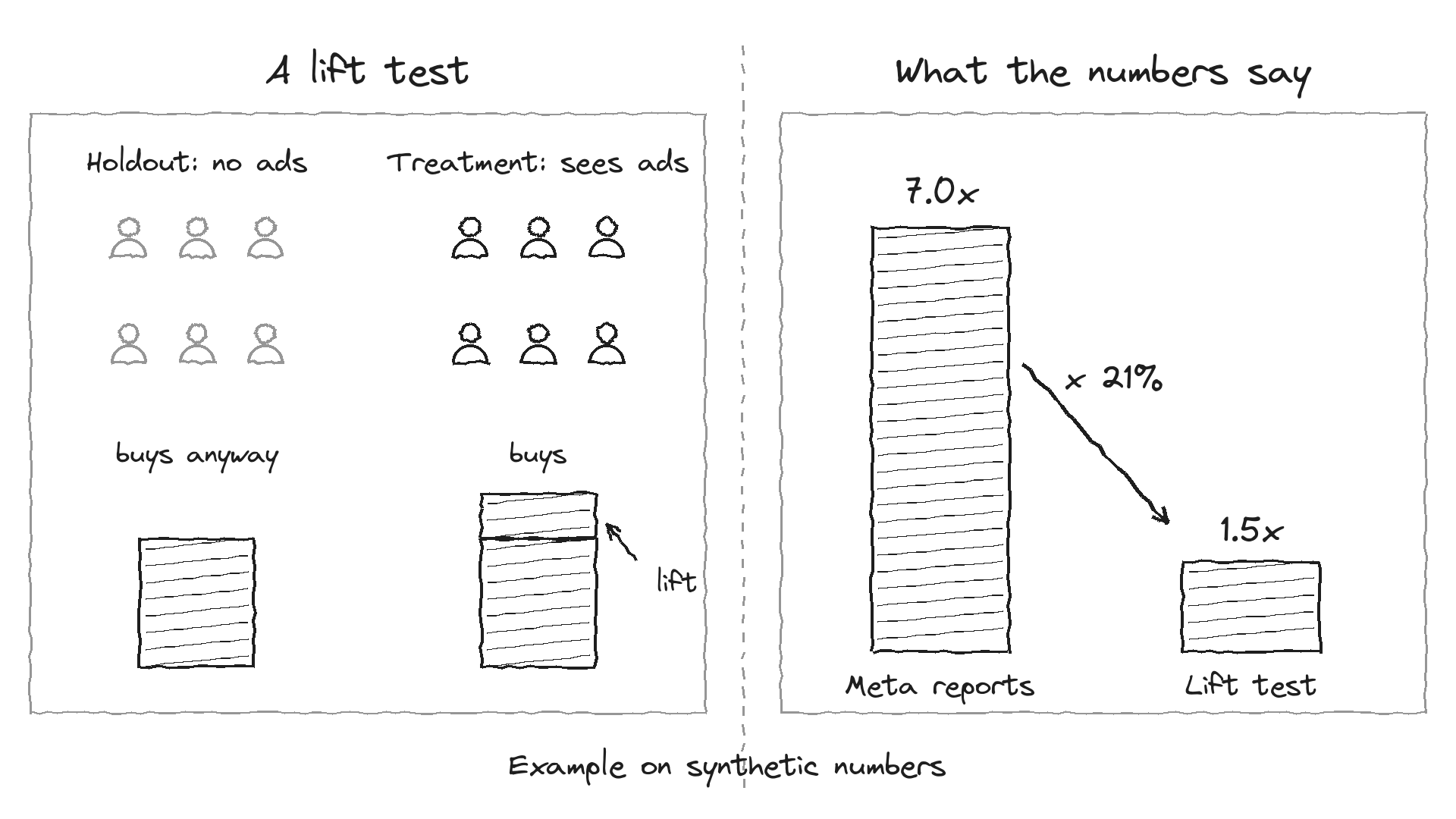
Careful with magic multipliers, though, because one test is one snapshot. I'd run the lift test more than once to see how stable that multiplier is before I lean on it for budget calls.
Can I check without a lift test?
Softly, yes. These won't settle it (only a lift test does), but they can tell you where to look first.
Does a short attribution window hold up?
Compare ROAS across attribution windows. If your 1-day click ROAS is almost as high as your more generous windows (7-day click, or 7-day click plus 1-day view and 1-day engage-through), or at least meets your goals, maybe your ads are really doing something. If most of the credit only shows up in the generous windows, be more suspicious. (Note that click-through now counts link clicks only.)
Where are the ads running?
Break results out by placement. If a lot of your delivery runs on Audience Network, I'd bet those ads are more "observing" sales than causing them. Especially if your window includes 1-day view.
Who is buying?
Define your engaged and existing customer segments in Meta's ad account settings. Meta treats everyone else as new. The breakdown is for sales campaigns and may not be available in every account. Then break performance down by segment. A retargeting campaign that brings in plenty of new customers may be adding business you wouldn't have done anyway. One that mostly reaches people who were about to buy again is the one to test first.
What should I do next?
Run the lift test, then run it again.
If it comes back lower than Meta's number, good. Now you know what your retargeting is really worth. If you want a second set of eyes on the setup or the read, here's how I work with brands on testing.
Happy advertising, and reach out with questions!
Not sure what your retargeting really adds?
Bring the report you don't trust. I'll help you plan a lift test that shows how many sales the ads created, not just claimed. One-off and short projects are fine.
FAQ
Is Meta retargeting incremental?
Sometimes, partly. Meta reports the sales your ads were near (observed sales). A lift test with a holdout group shows how many of those sales the ads caused.
How do you calculate iROAS?
Take the treatment group's revenue minus the holdout group's revenue, with both scaled to the same size, and divide by ad spend.
What is an incrementality factor?
It's iROAS divided by platform-reported ROAS. You multiply future platform-reported results by it to estimate their incremental impact, and re-test before trusting it.
Can I tell if retargeting works without a lift test?
Only softly, by comparing attribution windows, placements and new versus returning customers. These point you where to look, but a lift test settles it.